


DEDICATED 100% TO THE GLOBAL TANK STORAGE INDUSTRY

Since 1954, PROTEGO® has built and provided flame arresters, valves and tank equipment, now with the help of more than 750 employees worldwide. We are the technology leader within our area of expertise. We provide global services for our customers which include research and development, application-specific engineering, overall protection system design and safety awareness training. Our customers know they can rely on our research capabilities, engineering expertise and high quality products for the up and downstream oil and gas, petroleum, chemical, pharmaceutical and bio-energy industries.

PROTEGO® is a world market leader operating with a large global network of subsidiaries and representatives. The PROTEGO® Team includes 10 distribution and after-sales service companies as well as 120 representatives in all continents.
PROTEGO® subsidiaries: Austria, Brasil, China, France, India, Middle East, Spain, Switzerland, UK, USA

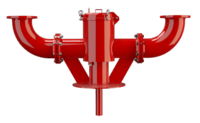
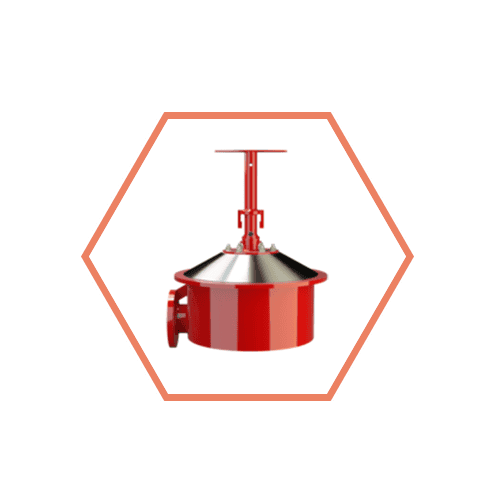
PROTEGO® lift-actuated vent valves type AL/DK provide automatic venting of floating roof tanks when the floating roof is lowered onto its supports and the tank is either drained or refilled. When the floating roof is in its lowest position, the valve is forced to open through lift actuation, which prevents inadmissible vacuum during final draining or inadmissible pressure during refilling.
The PROTEGO® AL/DK valve consists of a housing (1) with a sheet metal panel to be welded onto the floating roof, two or four connection nozzles (2) for installation of vent caps, cover (3), lift (4) including valve disc (5), lift pipe (6), and the condensate drain valve (7) which can be designed to be flame transmission proof. The condensate drain is sealed by a flat gasket attached to the valve disk (5). The cover (3) is sealed by a sealing cord (8).
In general the device PROTEGO® AL 200 consists of a housing (1) with sheet-metal panel to be welded on the floating roof as well as the valve seat (2), lift (3) including valve pallet (4) and lift pipe (5). A flat gasket (6) provides sealing.
As the lowest position of the floating roof varies for operation and assembly, specify the dimensions h1 and h2:
h1: Distance between the lower edge of sheet-metal panel (or mounting flange) and the tank bottom in lowest position of floating roof (operating position with an empty tank).
h2: Distance between the floating roof in lifted maintenance position and the height of the floating roof in fully lowered operating position (operating position with an empty tank).
If the floating roof supports are changed from operating position to maintenance position, the lift has to be extended as well. This is done with an adjustable locking pin that is secured with a split pin.
The valve is not flame transmission proof.
Based on a hazard analysis with regard to material selection and function, the valves have no potential ignition sources. As a result, they are not subject to the European Explosion Protection Directive (ATEX) when used in explosive atmospheres.
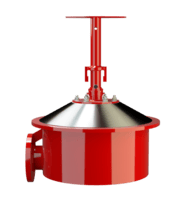
The PROTEGO® roof drain valves D/SR or D/SR-W have the function of an inlet cup, which collects the rainwater from the floating roof through the scissor pipes of a PROTEGO® floating roof drainage system, e.g., SE/K or SE/CK, into the sewage system.
Under normal operating conditions, the roof drain valve is open. In case of any leakage, the non-return valve prevents the stored substance from escaping to the floating roof. The inlet screen protects the roof drain valve from any dirt, leaves, or nesting animals.
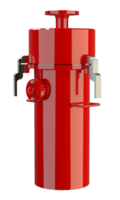
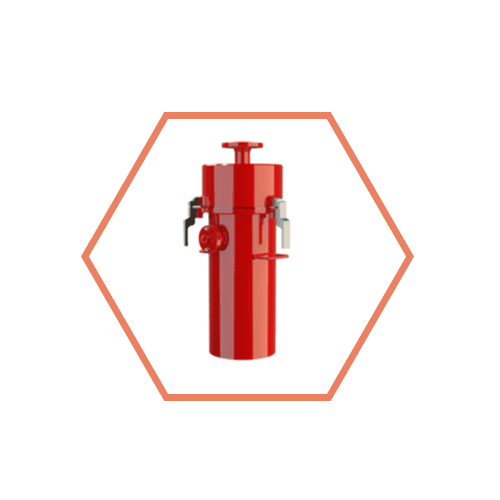
PROTEGO® air-drying device of types LA or LA/V is used when suction air must be dried for atmospheric venting of storage tanks where only little or no humidity is allowed to get into the tank or the stored product due to the process engineering. They are usually used in vertical or horizontal aboveground tanks which store non-flammable or flammable liquids, and which must not be vented with humid air for safe operation.
The single device PROTEGO® LA mainly consists of the drying agent container (1). Its snap closing elements (2) connect it to the connection head (3) with flange connection according to DIN 2501 or to any other international standard.
The bottom screen (4) and the protective strainer (5) are firmly welded into the drying agent container (1). The upper strainer cover (6) is loose. It can be removed easily to add or remove the drying agent. The connection head (3) contains the sealing plate (7) that closes the connection head opening when taking the drying agent container off. No humid air can be sucked in when changing the drying agent container.
The upper part of the drying agent container (1) holds the integrated control cartridge (8). The control cartridge can be removed during operation. It shows if the drying agent contains humidity and has to be replaced for regeneration.
Depending on the required flow rates or prescribed pressure losses the drying agent containers are delivered in two sizes – type I or type II. As parts of a modular system they are assembled into larger performance units.
KC® drying pearls are used as the drying agent. The control cartridge (figure 1) is filled with special KC® indicator drying pearls. The required filling levels are specified in the relevant operating instructions.
The air-drying device type LA/V is essentially similar to type LA. Additionally, it has a replaceable check valve (9) with protective strainer and valve pallet (10) integrated in the inlet connection. When no air is sucked in through the air-drying device the device is sealed and tight towards the atmosphere. So at high air humidity the drying agent in the lower area of the drying agent container cannot absorb moisture.
The FEP diaphragm with air cushion sealing (figure 2) is used as valve pallet sealing up to pressure range II. From pressure range III, a lapped metallic sealing is used (figure 3). Air-drying devices of types LA or LA/V may be integrated into complete tank venting systems (see figures 4 and 5).
If flammable liquids are stored in the tank, then flame arresters have to be installed in addition to the air-drying device and the pressure and vacuum relief valves. Depending on the operating conditions it is also possible to combine other vent valves with the integrated air-drying device.
When the set vacuum is reached in the tank, the vacuum relief valve – for instance PROTEGO® type DZ/T or DV/ZU on figures 4 and 5 – connected to the air-drying device opens and the drying device LA sucks in atmospheric air while the drying agent (KC® drying pearls) absorbs the atmospheric humidity.
The drying agent must be replaced and regenerated when depleted. Using a control cartridge, it is easily possible to determine whether the drying agent is saturated with humidity.
If the specified pressure is reached in the examples shown in figures 4 or 5 the pressure side of the combined pressure and vacuum relief valve opens and the product vapour/air mixture escapes into the atmosphere. The valve could be for instance PROTEGO® type VD/SV or DV/ZU. Alternatively it is possible to pass the product vapour/air mixture through a suitable valve – e.g. PROTEGO® type DV/ZU into an exhaust line or exhaust system. Under pressure the vacuum side of the above valves remains closed and the product vapours cannot pass into the drying agent.
In larger tanks it is recommended to also use combined pressure and vacuum relief valves e.g. PROTEGO® type VD/SV. This ensures that in an emergency (failure of air-drying device) atmospheric air can be sucked in directly through the vacuum side. Often direct atmospheric emergency venting is required yet it is neither possible nor necessary to size the air-drying device for the maximum volume flow calculated (pump flow-rate and thermal flow according to EN 14015 or API 2000). Maximum thermal flow occurs only rarely and it is therefore usually sufficient to size the air-drying device according to the pump flow-rate for emptying and a thermal flow portion of approximately 25%.
Essentially, the air-drying device type PROTEGO® LA/V functions like type PROTEGO® LA. However, a check valve allows inbreathing only when the entire venting system – the tank and the drying container – is under vacuum at the set pressure of the check valve.
The devices are designed for venting rates sufficient for the breathing of storage tanks. However, they do not replace any valves designed for emergency venting.
The drying agent saturation can be easily monitored using a control cartridge. The drying agent can be regenerated. Drying agent and control drying pearls are not included in the PROTEGO® LA or LA/V and can optionally be ordered together with the device.
Figure 6 shows the combination options of PROTEGO® LA/V air-drying device in complete units. The overall dimensions, filling volumes and filling weights are also given in this figure.
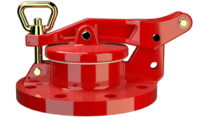
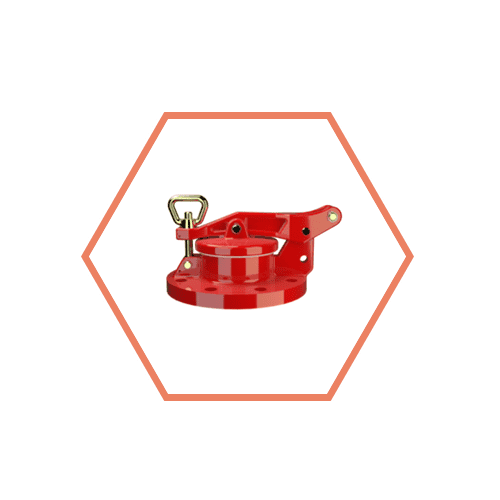
PROTEGO® gauge hatches types PF/K, PF/TK, and PS/KF are used as lockable gauge nozzles which are only opened for gauging or sampling. Otherwise, they are tightly closed.
The gauge hatches PROTEGO® PF/K, PF/TK, and PS/KF mainly consist of housing, gauging nozzle lid, and gauging nozzle bracket. The housing is equipped with stainless steel gauging marks as standard.
In the pedal-operated version PROTEGO® PF/TK, the gauging nozzle pedal is connected to both the housing and the bracket.
